
Fast Track or Fast One?
Marion County Rushes Through a Secretive Tax Deal for Project Liberty and the Land Trail Raises Even More Questions

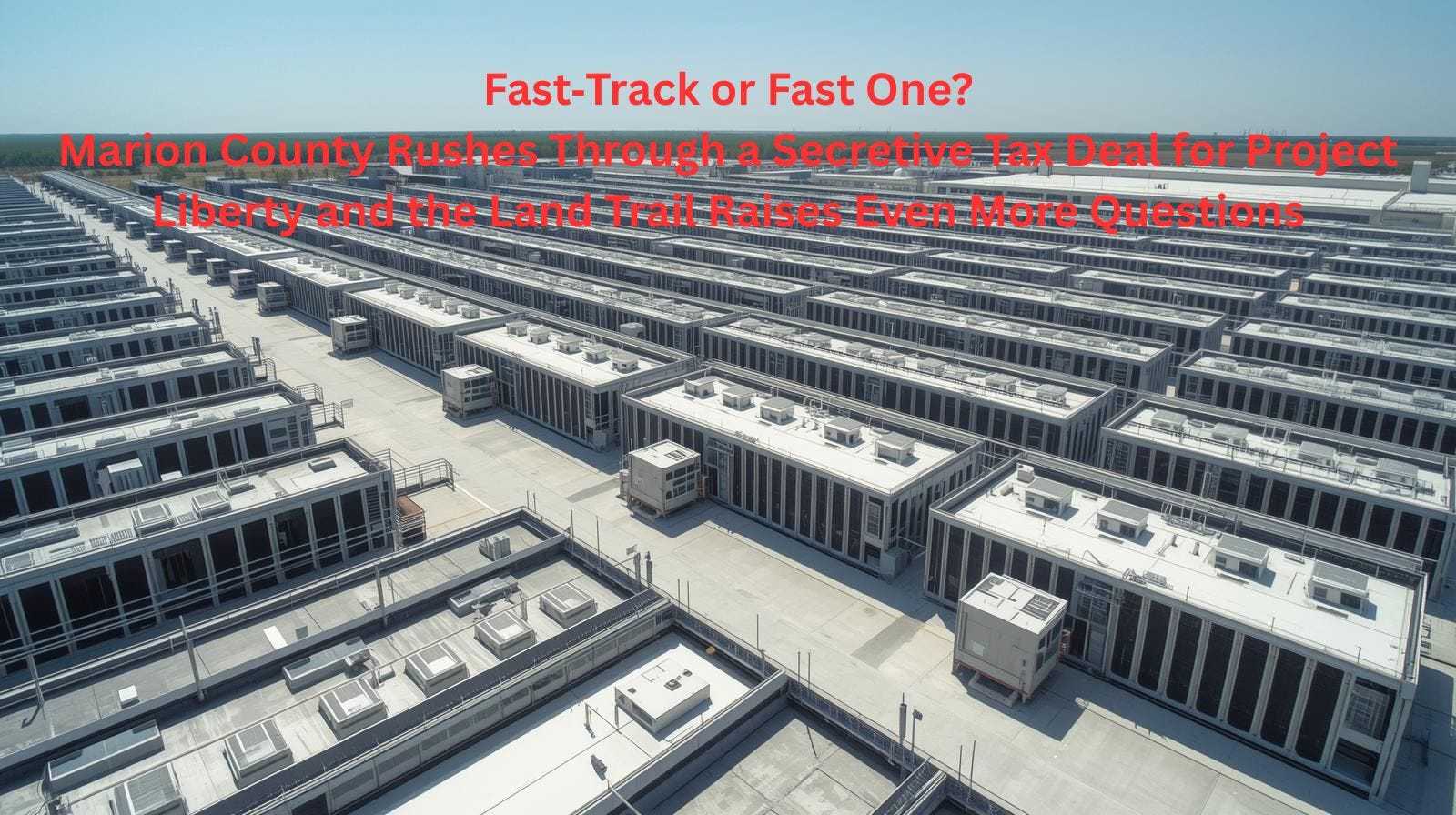
By The Staff
In just sixteen days, Marion County Council approved Ordinance #2026‑01, in a 6 to 1 vote, a complex corporate tax deal that could define the county’s finances for half a century.
The official story calls it a bold move to attract an $800 billion investment. But project documents, land records, and the blistering speed of the approval vote, tell a different story one of secrecy, insider maneuvering, and public exclusion.
The ordinance authorizing incentives for Project Liberty now known to be Eagle MYRA, LLC breezed through all three mandatory readings in barely over two weeks:
1st Reading: Tuesday, Jan 6, 2026
2nd Reading: Tuesday, Jan 13 (+7 days)
3rd Reading / Final Vote: Thursday, Jan 22 (+9 days)
Total: 16 days.
Ordinarily, county councils spread those readings over six to eight weeks to gather public input and perform fiscal due diligence. Marion skipped that step entirely. You don’t move that fast unless it’s already a done deal.
Eagle MYRA LLC registered in Delaware and operating under the code name Project Liberty is slated to receive three major tax breaks:
Fee‑in‑Lieu of Tax (FILOT): cheaper, negotiated annual fees replacing normal property taxes, dropping effective corporate rates from 10.5 percent to about 4–6 percent for up to 53 years.
Multi‑County Industrial Park Designation: makes the project eligible for extra state‑level rebates by joining with Dillon County.
Special Source Credits: let the company claw back a portion of even those discounted taxes to offset infrastructure costs.
In plain English: massive tax discounts + potential rebates.
Perhaps the most significant revelation lies underneath the concrete in county land records.
Before the ordinance appeared, a 500 acre tract quietly changed hands.
Roughly 100 acres of it were transferred from the county to a second private party, who then sold that parcel back to the Project Liberty entity at a markup just weeks before the council’s first vote. Did Marion County receive any payment for this land, if so, how much?
All 500 acres are under the company’s control, forming the core of the proposed facility site.
Officials insist the transactions were unrelated, yet the sequence multiple transfers, same parties, and precision timing ahead of a confidential tax agreement has fueled speculation that insiders profited from land arbitrage before the public knew a deal was coming.
What will the deeds and plats show. The ownership trail has yet to be uncovered. Somebody knew before the rest of us did. Did they profit from the transaction, if so, who and how much?
So many questions need to be answered.
South Carolina’s Negotiated (FILOT) Act legally allows counties to hide a project’s identity until final approval, ostensibly to protect competitive interests.
In practice, this confidentiality works like a blackout curtain.
By the time the public learns who the company is, the ordinance is law and any opposition is ceremonial.
Critics call the delayed disclosure the oldest trick in the development book. Every dollar abated in property taxes is a dollar lost to schools, fire protection, and libraries, yet those trade offs remain invisible until after the ink dries.
Under the Marion Dillon Industrial and Business Park framework, both counties will split (FILOT) payments. After debt and expenses are recouped, Marion County’s leftover revenue will trickle into local accounts:
10% → Economic Development Fund
10% → Capital Projects Fund
10% → Public Safety Fund
25% → Marion School District
45% → General Fund
But that’s after infrastructure bonds and corporate reimbursements are paid off meaning the first meaningful revenues could be decades away.
County Council Chair Dewayne Tennie, Interim Chief Administrator Senator Kent Williams, and the Clerk to Council were granted sweeping authority to finalize details, certify signatures, and approve minor changes without public votes.
A severability clause ensures the ordinance stands even if parts are struck down, and a supremacy clause declares it overrides conflicting local laws.
Once adopted on January 22, the ordinance took effect immediately no referendum, no phased roll out, no public hearing beyond the minimum legal requirement.
Some leaders herald the deal as visionary. “It puts Marion back on the industrial map,” said one council member.
Others privately confess unease: “Sixteen days, a mystery company, a land flip and half a century of tax forgiveness. We’ll be living with this long after these officials are gone.”
The South Carolina Bulletin has called on the County to release: A public disclosure of job and investment commitments, the calculated total of foregone tax revenue, and the names of all landholders and intermediaries connected to the 500 acre purchase and 100 + acre parcel that was transfer from the county to other unnamed sources.
Neighboring counties now post such data online. Marion has not.
Despite the secrecy surrounding Project Liberty, its sheer size raises serious questions about water consumption, energy demand, and environmental impact. An $800 million facility of industrial scale will inevitably require vast amounts of electricity and water resources already stretched thin in parts of Marion County. Residents worry that the county may be subsidizing not just the company’s taxes, but also its utilities, infrastructure hookups, and waste management. Without open environmental assessments, no one knows how much groundwater the project might draw, what emissions or byproducts could affect local ecosystems, or how increased power usage might strain the grid. The rush to approve the deal left no opportunity for public review or environmental due diligence, suggesting that economic promises once again eclipsed ecological reality.
“This isn’t anti‑growth,” the Bulletin editorial board argues. “It’s about accountability and transparency. If taxpayers are bankrolling corporate expansion, they deserve to know who’s cashing in and who’s behind it.”
If promises hold, Project Liberty could anchor new jobs over time, strengthen local infrastructure, and increase regional prestige.
If the projections falter, Marion County will have traded tens of millions in future revenue for a patch of industrial land and the few who knew earliest may have already made their profit.
For now, Project Liberty remains a case study in how economic development can obey every line of state law while violating the spirit of public transparency.
The only liberty guaranteed so far belongs to those who negotiated the deal before anyone else even knew it existed.
If you value independent reporting in the Pee Dee region, subscribe to The South Carolina Bulletin. Transparency doesn’t happen by decree it happens when citizens start asking the questions their officials want to avoid.